|
"If
we do not learn and evolve from past events who will the public trust in the future?"
Mark V. Cerney
Mark Cerney founded the
National Next of Kin Registry (NOKR)
because of a
devastating and personal experience. An extended family member
of Mark’s known as “MiMi,” was the nanny to Mark and his sisters
for over two decades.
Mimi eventually became a resident of a convalescent care
facility in San Diego, California due to multiple strokes.
Mimi had been hospitalized for nearly a decade at the same
care facility. Over the years, Mark had informed new staff
repeatedly that if Mimi were near death or suddenly passed
on; he was to be notified immediately. Mimi had Mark
and his family listed as her immediate family contact in her
patient file. In
late May 1990, Mimi passed on. Neither Mark nor his family
members had been notified of her death or burial. The pain
of knowing Mimi had died alone was Mark’s grief for many
years. The frustration of what took place, the lack of
communication, and out of love for Mimi, NOKR was born.
On January
1, 1999, Mark began his research and case study on the information gap between
the public and the agencies needing rapid next of kin or
emergency point of contact information.
|
 |
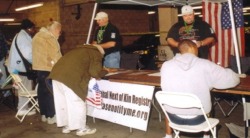
Volunteer Jim
Weaver, 75, takes a phone call from a woman in the
Hollywood, CA area who is looking for her father and
brother, who are from New Orleans. Weaver and others
are compiling names of the missing in a database for
the Next of Kin Registry (nokr.org).
DAVID CARLSON
Staff Photographer
|
|
|
In late 1999 Mark Cerney applied to volunteer at the Whatcom
County Fire Rescue department in Washington State in hopes of
delivering a new preparedness program. |
On January of 2000 Mark Cerney developed a community base
program called Community Care 2000. The first goal of this new
program was to follow up on all medical calls made by the Fire
District. The second goal was to compile a confidential file of
vital contact information for everyone living in the district.
This file simply would list who should be contacted if the
district responds to an emergency at a given address. The 3rd
goal of the community care 2000 was community education and
launching a fire district website aimed at keeping the community
informed.
The volunteer sprit of Fire Fighters and EMT’s in Bellingham,
Washington allowed for Community Care to grow.
Community care 2000 was a success but Mark knew that for the
impact to be greater that he had to develop a very robust but
user-friendly service with web applications.
The terrorist attack of September 11, 2001, the long overdue
void and the much-needed emergency next of kin locator systems
revealed more urgency as well as faults in the present system
and the necessity for a more simplified method of disseminating
information.
On Jan 1,
2004 NOKR was officially established. The service is paid for by
donations from our founder's family. In 2005 post Hurricane
Katrina Senator Barack Obama now United States President-Elect
introduced the National Next of Kin Registry to the 109th
Congress in S.1630, The National Emergency Family Locator Act.
The Next of Kin Registry was referenced in this bill as a
standard for the Secretary of Homeland Security to consider in
establishing the National Emergency Family Locator System.
In 2007 the US Federal Emergency Management Agency (FEMA)
consulted with the Next of Kin Registry in an effort to answer
HR5441 (Department of Homeland Security Appropriations Act,
2007), SEC. 689c. NOKR
put forth the requested solution for the National Emergency
Family Registry and Locator System (NEFRLS), which is being
established in compliance with Congressional Legislation SEC.
689c of H.R. 5441 to help
family members separated after major disasters to communicate
with one another.
As of today
NOKR is used worldwide as a free resource to prepare for
emergencies.
NOKR has proven to be crucial in daily emergencies and disasters
both domestically and abroad; the Asian Tsunami, London
bombing, Hurricane Katrina and Rita.
NOKR is a
volunteer driven organization that currently has volunteers
situated
in 87 countries
working to promote the FREE NOKR resource daily. The NOKR
continues to recruit on a continuous basis to develop human
resources in every part of the world. This enables NOKR to be
ready, and on the ground wherever needed globally.
|

 At The
End Of The Day,
It's All About Your Family.
At The
End Of The Day,
It's All About Your Family.